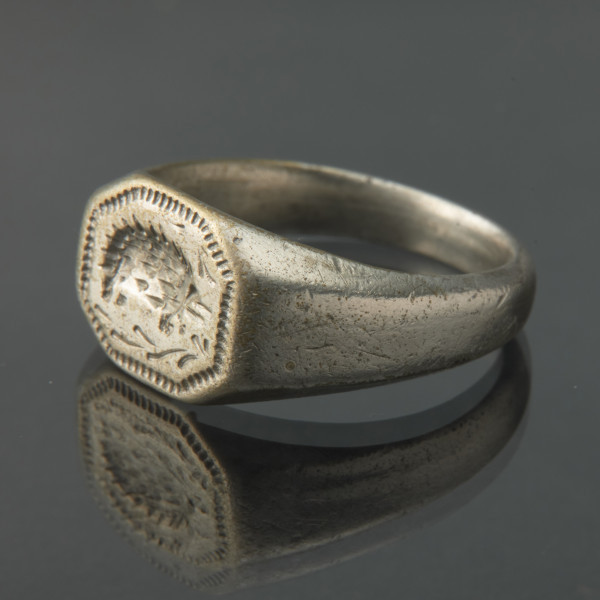
When I was in university, I met a fellow student who wore a signet ring with a hedgehog impressed in it. I was fascinated. He said women who married into the family would receive one and not gonna lie – it was tempting! Yes, the ring was that cute. The guy … not as much.
But the hedgehog has been a symbol for centuries. This intriguing example has a backstory: A signet, a kind of decorative ring, was intended only for men; originally, it was used as a seal. On its surface, it was usually engraved with an image of a coat of arms or a monogram as the owner’s distinctive sign. Rings fulfilling the function of a seal were already known in ancient Rome, where they were used as a personal signet ring used to authenticate letters. They were used throughout the Middle Ages, serving to legalise and protect documents against unauthorised persons. They were used by people holding important offices or positions. Bourgeois, representatives of the lower classes, used seals in the shape of polygons. Signet rings were often made of precious stones, which were set in gold or silver. They were worked in the intaglio technique, i.e. in-depth printing. Signet rings made entirely of precious metals were also popular, such as the example discovered in 1999 at Szczecin Podzamcze. Together with other jewellery items, costume ornaments and coins, it was found in a metal vessel hidden under the floor of one of the houses at Targ Rybny (the Fish Market). The valuables probably belonged to a local patrician. The ring is made of gilded silver and has a hexagonal mesh with an image of a hedgehog, which could have been an element of the Szczecin patrician’s coat of arms. In the Middle Ages, a hedgehog was a symbol of the devil, greed, and, due to its sharp spikes, a symbol of anger.